

The application of laser technology in manufacturing is currently a research focus in various countries. With the need for effective, environmentally friendly, and automated industrial development, the application of laser technology has rapidly spread to many fields of manufacturing. On this basis, laser welding technology will become one of the important aspects of laser applications.
Laser welding is an important part of the application of laser processing technology. With its high-energy beam focusing method, laser welding can achieve forms that are difficult to achieve in other welding processes such as deep penetration welding and rapid welding during the welding process. Especially with flexible equipment matching and mature real-time online detection technology, it can achieve high automation in large-scale production. Currently, a large number of laser welding production lines have been put into industrial production.
Practice has proven that laser welding has a wide range of applications in the processing industry. In areas where traditional welding techniques can be used, laser welding is capable of performing them, with higher welding quality and faster processing efficiency.
Welding process using laser technology
Laser welding is a process that utilizes the radiation energy of a laser to achieve effective welding. Its working principle is to excite a laser active medium (such as a mixture of CO2 and other gases, YAG yttrium aluminum garnet crystals, etc.) in a specific way, causing it to oscillate back and forth in a resonant cavity, thereby forming an excited radiation beam. When the beam comes into contact with the workpiece, its energy is absorbed by the workpiece, and welding can be carried out when the temperature reaches the melting point of the material.
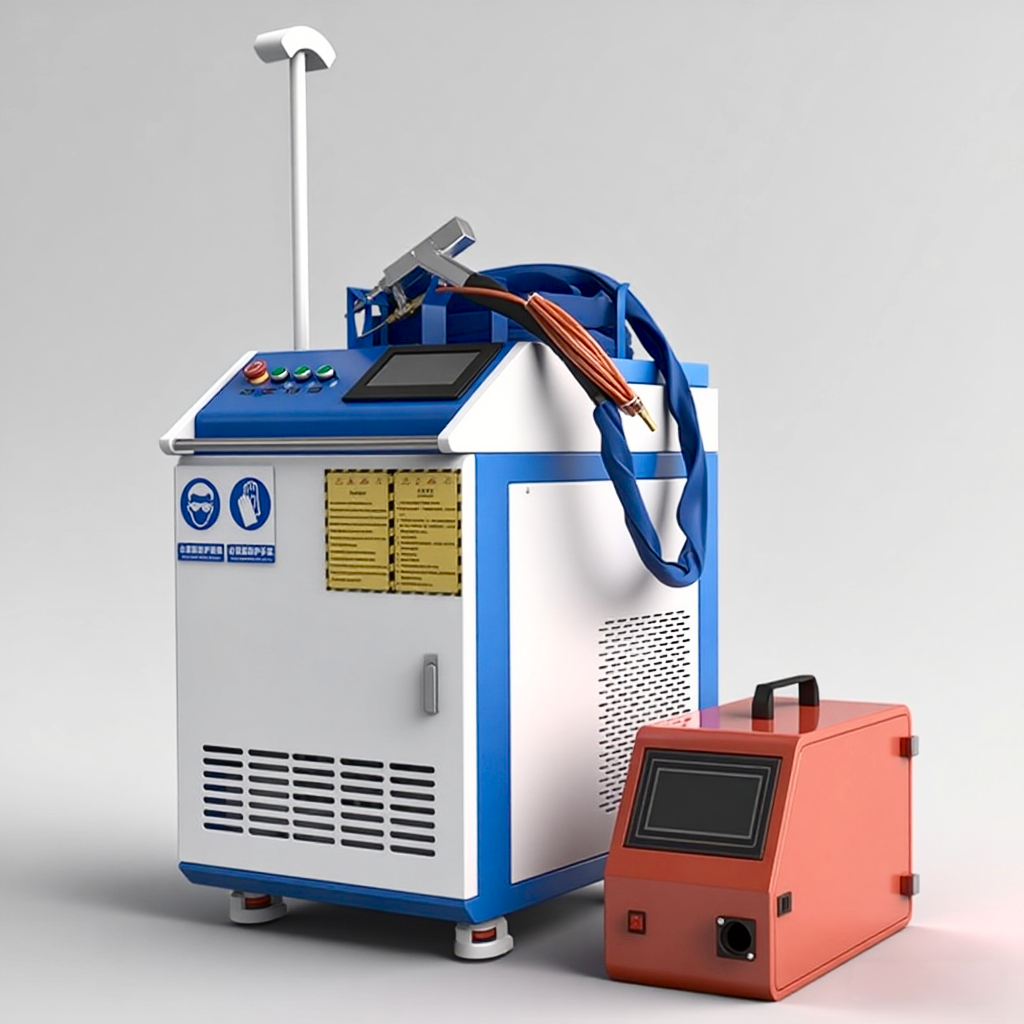
1. Mode of laser welding
Laser welding can be divided into heat conduction welding and deep penetration welding. The former spreads heat to the inside of the workpiece through heat transfer, only causing melting on the surface of the weld seam. There is no complete penetration inside the workpiece, and there is basically no vaporization phenomenon. It is mostly used for welding low-speed thin-walled materials; The latter not only fully penetrates the material, but also vaporizes it, forming a large amount of plasma. Due to the high heat, keyhole phenomenon occurs at the front end of the melt pool.
Deep penetration welding can fully penetrate the workpiece, with high input energy and fast welding speed, and is currently the widely used laser welding mode.
2. Weld seam shape and microstructure properties of laser welding
Due to the smaller focused spot area generated by the laser, its heat affected zone around the weld seam is much smaller than that of ordinary welding processes. In addition, laser welding generally does not require filling metal, so the weld seam surface is continuous, uniform, aesthetically pleasing, and free of surface defects such as pores and cracks. It is very suitable for occasions with strict requirements for the weld seam shape. Although the focused area is relatively small, the energy density of the laser beam is high (generally reaching 103-108W/cm2).
During the welding process, the metal is heated and cooled very quickly, and the temperature gradient around the molten pool is relatively large, resulting in a higher joint strength than the base metal, while the joint plasticity is relatively low. At present, joint quality can be improved through bifocal technology or composite welding technology.