

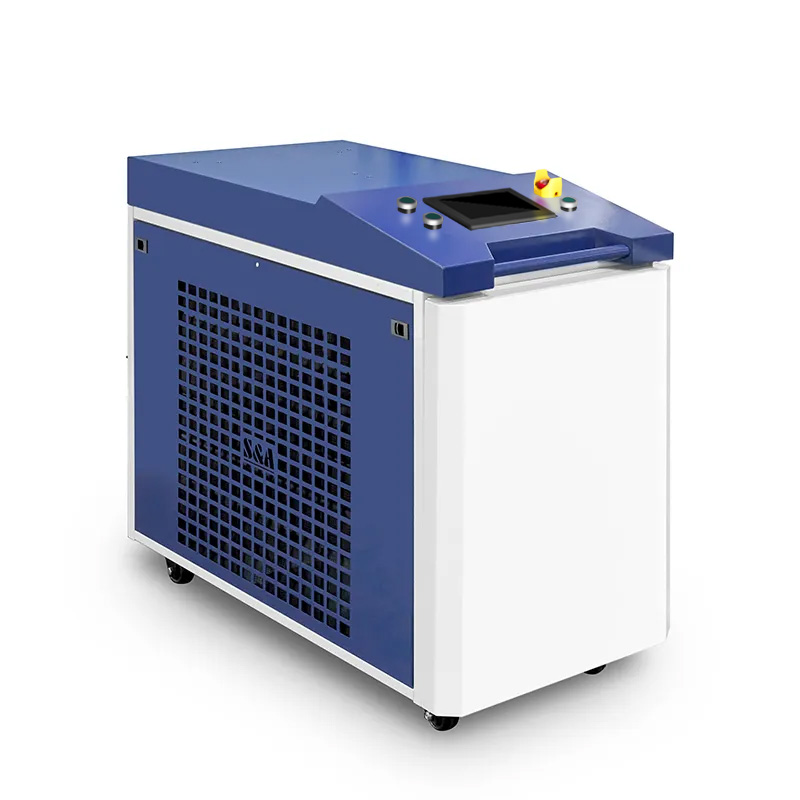
Laser cleaning technology has demonstrated revolutionary advantages in the field of automotive parts cleaning: compared to traditional chemical cleaning or sandblasting processes, laser cleaning does not require consumables and has a precision of micrometer level. It can selectively remove oxide layers without damaging the substrate. Its non-contact characteristics are particularly suitable for precision components, and a single device can adapt to different cleaning needs of parts, with program switching taking only 30 seconds. The environmental benefits are more prominent - eliminating the problem of chemical waste liquid treatment, with energy consumption only 1/5 of traditional methods. For sensitive components such as battery trays in new energy vehicles, laser cleaning can avoid insulation risks caused by traditional water washing. With the trend of automotive lightweighting, this process of cleaning aluminum alloy/carbon fiber composite materials is becoming a new industry standard.
The technical principle of laser processing glass
The core of laser processing of glass lies in utilizing the nonlinear interaction between high-energy photons and materials. Unlike traditional mechanical forces, lasers cause localized ablation or modification of glass through focused high energy density (typically up to 106-1012 W/cm2). Among them, ultrafast lasers, due to their extremely short pulse width (femtosecond level) and high peak power, can reduce the heat affected zone (HAZ) through the "cold working" mechanism, thereby achieving crack free and high-precision machining effects. For example, femtosecond laser can directly form micropores or modified layers inside glass through multiphoton absorption effect, and then complete cutting through chemical etching or mechanical separation.
Multi layer structure processing: efficient processing of automotive and architectural glass
The traditional processing of laminated glass (such as car windshields) requires layer by layer cutting and is prone to delamination. Laser can precisely ablate the middle PVB film layer through the principle of wavelength selective absorption, thereby achieving complete detachment of the outer glass layer. The green laser system of TRUMPF in Germany has been used for processing BMW car sunroofs, increasing processing efficiency by 4 times and reducing energy consumption by 60%.
Technological advantages and economic benefits
Compared with traditional processes, the core advantages of laser processing of glass are reflected in: a leap in precision: processing resolution of micrometer level, suitable for high-end fields such as 5G antenna glass and MEMS sensors; Enhanced flexibility: The processing pattern can be switched through software programming to meet the needs of small batch customization; Environmental friendliness improvement: No need for coolant or chemical etchants, reducing waste disposal costs; Comprehensive cost reduction: Taking mobile phone glass processing as an example, the investment payback period of laser equipment has been shortened to less than 2 years, and the cost of single piece processing has been reduced by 40%.
Future development trends include: composite processing technology: combining lasers with robots and machine vision to achieve fully automated processing; Wavelength extension: Mid infrared lasers (such as the 3 μ m band) can improve the processing efficiency of quartz glass; From laboratories to production lines, laser technology is reshaping the industrial landscape of glass processing. With the cost reduction of ultrafast lasers and the iteration of intelligent control algorithms, laser processing will not only be limited to high-end manufacturing, but may also penetrate into people's livelihood fields such as building decoration and medical equipment.