

In countless workshops of modern factories, an invisible beam of light is quietly changing the face of manufacturing. The laser welding machine, with its precision of 0.1 millimeters, can permanently connect two pieces of metal without even emitting the dazzling arc light and splashing sparks of traditional welding. This almost "invisible" technological revolution is reconstructing the entire manufacturing system from microelectronics to spacecraft.
The core charm of laser welding lies in its ability to elevate energy control to the quantum level. When a fiber laser with a power of 3000 watts focuses the beam onto a spot with a diameter of 0.6 millimeters, its energy density can reach 10 ^ 6 watts per square centimeter, which is enough to instantly vaporize the steel surface and form a keyhole effect in milliseconds. This metallurgical process under extreme conditions can achieve astonishing accuracy of weld width error not exceeding ± 0.05 millimeters under computer control. At a new energy vehicle battery factory in Shanghai, a fully automated production line consisting of 128 laser welding machines can seamlessly connect over 20000 battery modules per day, with an efficiency 17 times higher than traditional resistance welding.
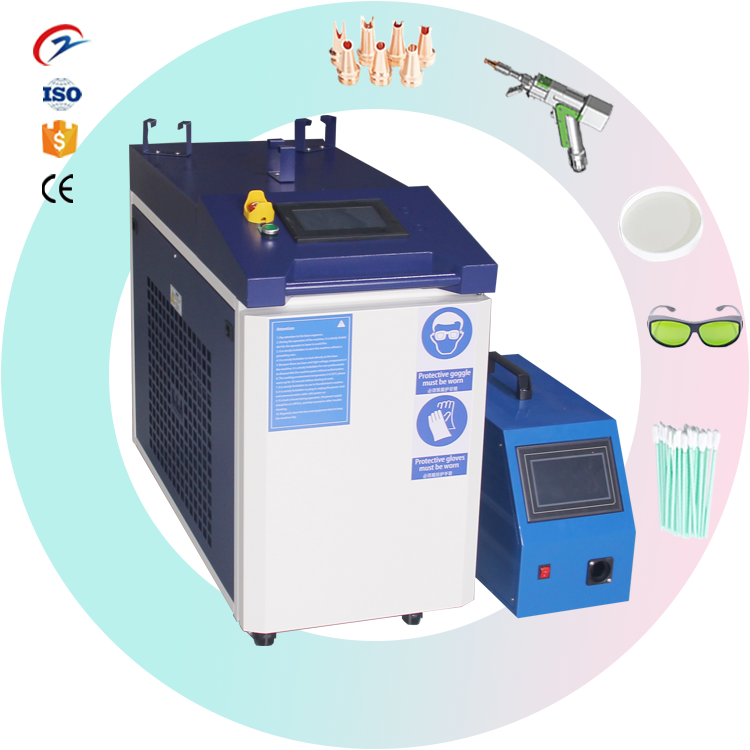
The brilliance of this technology is further reflected in its control of the thermal impact on materials. By adjusting the pulse frequency (up to 1000Hz) and duty cycle, laser welding can reduce the heat affected zone to 1/10 of traditional arc welding. Engineers from Beijing Satellite Manufacturing Plant have successfully controlled the welding deformation of aluminum alloy spacecraft fuel tanks within 0.1mm/m by utilizing this characteristic. Even more astonishing is that when using near-infrared lasers with a wavelength of 1070nm, the beam can even penetrate glass and directly weld its internal metal components. This technology has been widely used in the manufacturing of sealed medical devices such as pacemakers.
Laser welding machines are writing new industrial aesthetic standards. At the BMW factory in Munich, a robot wielding a laser welding gun glides across the roof contour at a speed of 3 meters per second, leaving behind a perfect weld seam with a width of only 0.8mm and a surface roughness of Ra0.8 μ m, which does not require any further polishing. This "cold welding" process allows concept car designers to boldly use 0.6mm ultra-thin steel plates without worrying about thermal deformation. A more profound impact occurs at the micro level: by precisely controlling the cooling rate, laser welding can form ultrafine grain structures in the weld area, resulting in a joint strength that is 15% higher than the base metal.
From the precision packaged interior of smartphones to the soaring space station cabin, the invisible connection points created by laser welding are supporting the entire modern technological civilization. This process of converting photon energy into metal bonding energy not only represents the pinnacle of manufacturing precision, but also symbolizes an essence of industrial evolution - true technological revolutions often occur in the microscopic world that is invisible to the naked eye. As the manufacturing industry enters the era of nanoscale competition, the silent blade of laser welding machines is cutting new boundaries for future industry.