

1、 Overview of Fiber Laser Welding Machine
Fiber laser welding machine is a revolutionary processing equipment in the field of industrial manufacturing in recent years. It uses a high-energy density laser beam as a heat source and guides the laser accurately to the surface of the workpiece through a fiber transmission system, achieving efficient and precise welding processes. Compared with traditional welding techniques, fiber laser welding has significant advantages such as energy concentration, small heat affected zone, fast welding speed, and high degree of automation. It has become an indispensable processing tool in high-end manufacturing fields such as automotive manufacturing, electronic components, medical equipment, and aerospace.
2、 Core technical principles
The core of fiber laser welding machine lies in its unique optical system design. The device first excites ytterbium doped fiber with a semiconductor laser pump source to generate laser, which is amplified by a resonant cavity to form a high-power continuous or pulsed laser beam. This laser beam is transmitted to the welding head through a flexible optical fiber, and with the help of a collimation and focusing system, it can form a small diameter (usually 0.1-0.5mm) but extremely high energy density spot on the surface of the workpiece (up to 10 ^ 6-10 ^ 7 W/cm ²).
During the welding process, the metal material rapidly melts or even partially vaporizes under such high energy density irradiation, forming a keyhole effect with a large aspect ratio. The molten metal re solidifies under surface tension and auxiliary gas, forming high-quality welded joints. By precisely controlling parameters such as laser power, pulse frequency, focal position, and welding speed, various process requirements from micrometer level precision welding to thick plate deep penetration welding can be achieved.
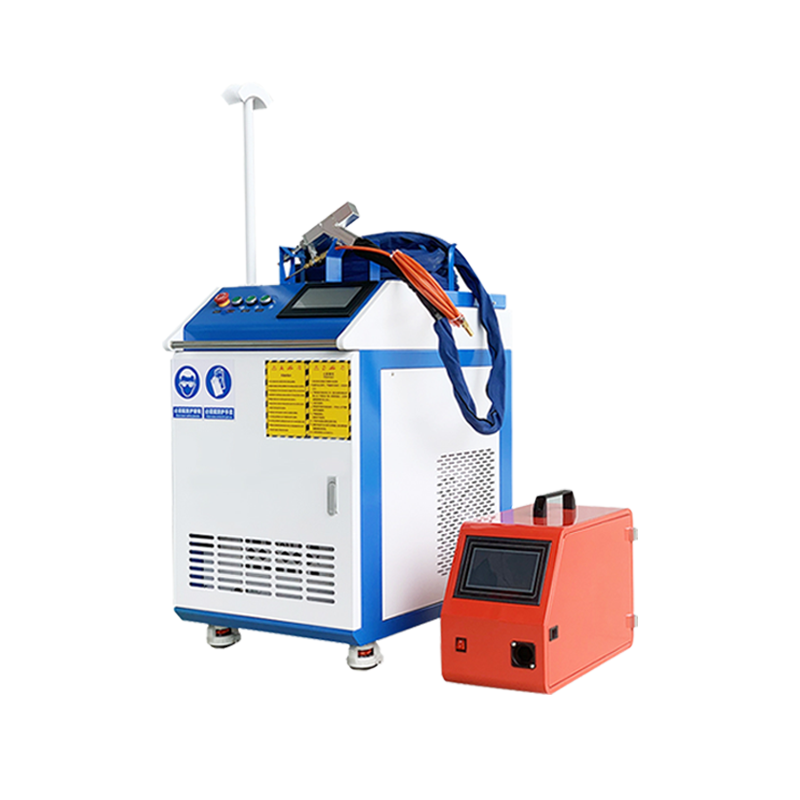
3、 Equipment composition architecture
A complete fiber laser welding system typically consists of the following key subsystems:
Laser generator: Using ytterbium doped double clad fiber as the gain medium, it outputs near-infrared laser with a wavelength of around 1070nm, with a power range ranging from tens of watts to tens of thousands of watts.
Beam transmission system: including fiber couplers, transmission fibers (usually with a core diameter of 50-300 μ m), and welding joints, ensuring efficient and non-destructive transmission of laser to the processing position.
Motion control system: high-precision CNC worktable or robot arm, combined with CCD visual positioning, to achieve precise welding of complex trajectories.
Auxiliary system: including inert gas protection devices (commonly argon and nitrogen), water cooling units, smoke exhaust and dust removal equipment, and safety protection facilities.
Intelligent monitoring system: Modern high-end equipment is equipped with real-time quality control modules such as melt pool monitoring and plasma spectroscopic analysis.